
Bangkok floods for structural reasons, not bad luck. The city sits on the Chao Phraya River delta, roughly 1–1.5 metres above mean sea level. Monsoon rain arrives in intense bursts from May to October, high tides in the river slow down outflow, decades of groundwater pumping have caused land subsidence, and an aging canal network carries garbage and sediment that choke its capacity. When the rain is strong enough, water has nowhere to go.
For contractors, municipal teams and industrial estates working in and around Bangkok, that means one thing: drainage capacity has to be engineered, not hoped for. This guide explains how to choose pumps for Bangkok’s monsoon waterlogging — permanent stations, gate retrofits and emergency dewatering.

What Bangkok’s Geography Demands from a Pump
The city’s conditions define the equipment, not the other way around:
- High flow at low head. You are moving rainwater and canal water a few metres, not lifting groundwater from a deep well. Flow rate decides how fast a flooded street, factory floor or underpass clears.
- Debris tolerance. Bangkok’s stormwater carries leaves, plastic, silt and sediment. Pumps must handle dirty water without constant clogging.
- Work with existing infrastructure. Much of the city’s drainage relies on older canals and sluices. Upgrades that avoid rebuilding are cheaper and faster.
- Reserve capacity for peak events. A station sized for an average rainy day is undersized for the day that matters.
Match the Pump to the Job
Permanent drainage stations and industrial estates
For fixed stations protecting districts, factory zones and commercial areas, the QGWZ full tubular (through-flow) submersible pump is built for exactly this duty: high flow at low head, a compact axial package, and a wet-stator motor whose windings are designed to run immersed. Where a station must drain in the wet season and supply water in the dry, the QGWZS version pumps in both directions with published forward and reverse performance data.
Upgrading existing sluices and canals
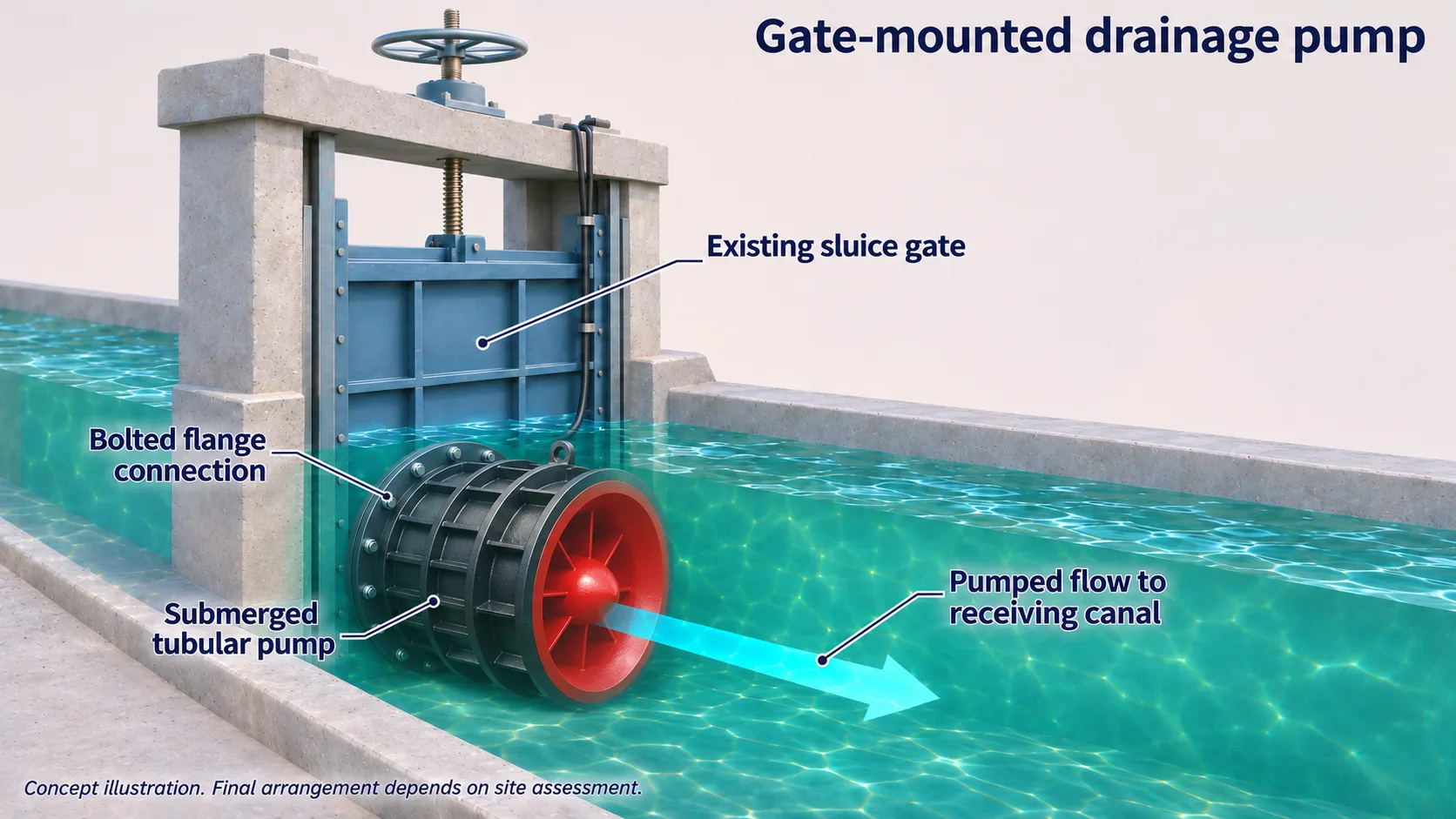
When an older sluice needs more capacity, the QGWZ/QGWZS gate pump flange-mounts directly onto the existing gate — a “zero-civil-work” upgrade that turns the sluice itself into the drainage system, with documented installations at 600–1000 mm outlets. For canal-side communities, this is often the fastest route to meaningful capacity.
Monsoon emergencies and temporary sites
For flash floods, underpasses, construction pits and temporary duty, QZB mobile pump stations on sled or pontoon frames deploy without any fixed structure. In 2016, eight such units were allocated by China’s National Flood Control Headquarters for flood-relief work in Hunan, as reported by Hunan TV — the same use case Bangkok faces every monsoon.
Dirty water with rags and fibers
Stormwater mixed with sewage and street debris needs more than hydraulics. For rags, plastic and fibers, a cutter pump shreds soft solids at the inlet; for general sewage transfer, the QWB non-clog series handles bulky solids. Our sewage and cutter pump guide explains the difference.
Sizing for Bangkok: The Four Numbers
- Required flow — the volume to clear and the time allowed, or the inflow rate you must keep up with during a downpour.
- Total dynamic head (TDH) — the level difference between the flooded side and the canal or river, plus pipe friction. Include the tidal back-water level at its worst, not at low tide.
- Installation form — permanent station, gate-mounted, wall-coupled or mobile. This usually decides the model family before hydraulics does.
- Power supply — Thailand’s 50 Hz grid matches our standard builds, so no frequency conversion is needed; we confirm voltage and starting method per project.
Our general flood drainage selection guide covers the hydraulics in more depth. The online pump selector currently covers QJ borehole pumps, so for drainage work, send us the four numbers directly.
Proof That the Equipment Works at Scale
- Nanning Zhupaichong municipal drainage station — ten 1600QGWZ-50-1200 full tubular pumps, 1200 kW each at 10 kV, completed 2014.
- 2010 Guangzhou Asian Games water-transfer project — 24 units supplied.
- Verification — national first-class precision test centre with PMSCAT grade-1 accreditation (WTGB202500076, valid 2025–2030), testing up to 40 m³/s and 3,000 kW. Every pump is tested before dispatch — see our testing and quality inspection.
- Credentials — full tubular technology appraised by Tianjin authorities in 2015, a Ministry of Water Resources new-product appraisal in 2016 (No. 12), and a Dayu water-conservancy science and technology award (second prize) for large-scale submersible pump-station technology.
Timing Your Procurement Around the Monsoon
Drainage equipment bought during a flood arrives too late. The workable pattern for Bangkok is to size and order in the dry season, install and commission before the rains build, and keep mobile units on standby for peak events. If you are planning for next year’s monsoon, starting the duty-point review now is the cheapest step you can take.
FAQ
Will your pumps work on Thailand’s power grid?
Yes — Thailand runs on 50 Hz, which matches our standard builds. We confirm the exact voltage and starting method per project. If you plan to run on generators, tell us the generator capacity so we can verify the starting current.
Can one station both drain and supply water?
Yes — the QGWZS bidirectional series pumps in both directions with published performance data for each, so one installation can drain in the wet season and supply or transfer water in the dry.
Can you handle water with plastic, leaves and street debris?
Yes. Full tubular pumps pass particles up to one tenth of the nominal outlet diameter (about 160 mm on a 1600 mm unit) per the manuals; for rag- and fiber-heavy water we add cutter or non-clog options. Hard objects should still be screened out.
We have an old sluice with no room for a new pump house. What is the option?
The gate pump: it flange-mounts onto the existing sluice and needs no new structure — a “zero-civil-work” upgrade, documented at 600–1000 mm outlets.
Next Step
Browse pump station systems, or send your duty point — flow, TDH, installation form and power supply — through the contact page or on WhatsApp at +86 17695696995. Tell us the site is in Bangkok and we will size for monsoon conditions, not average days.